Paddle up
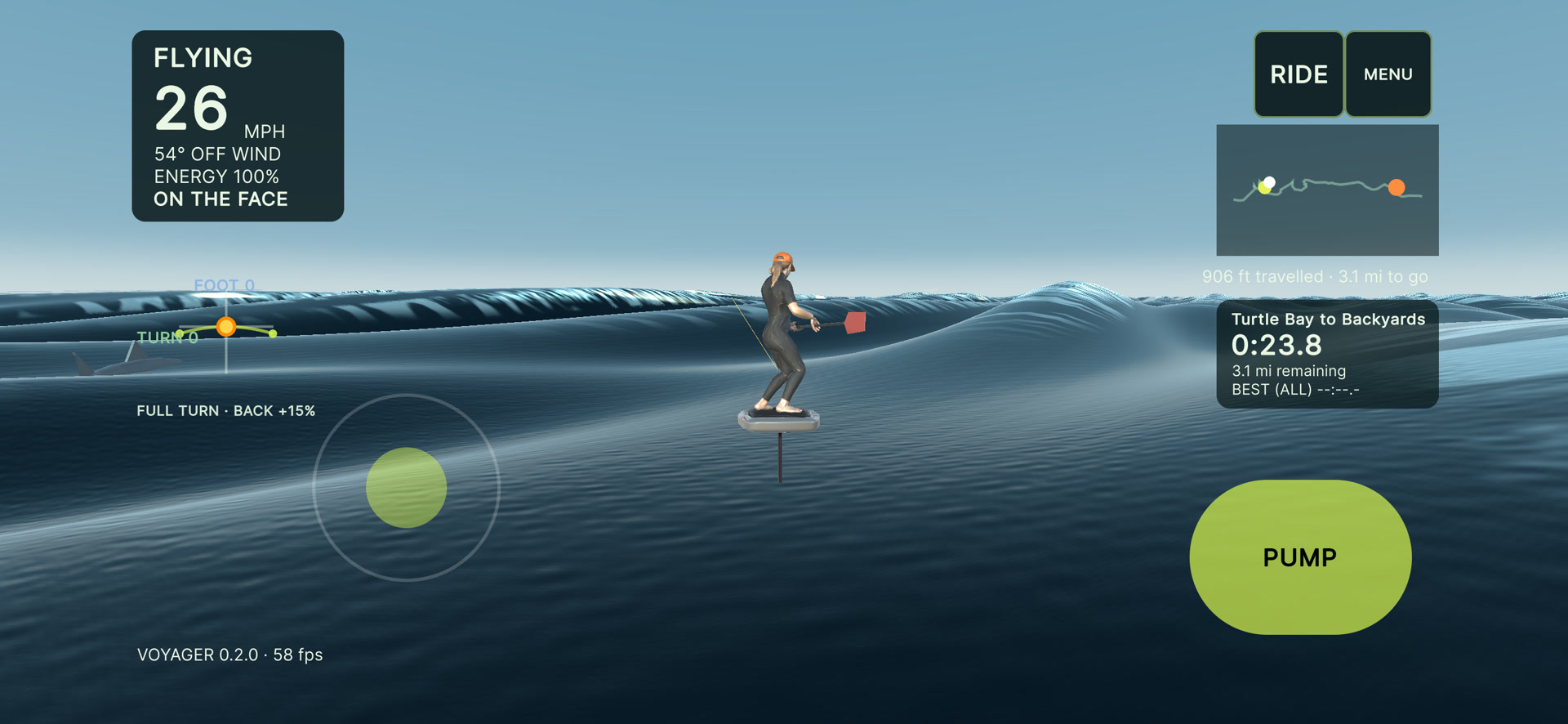
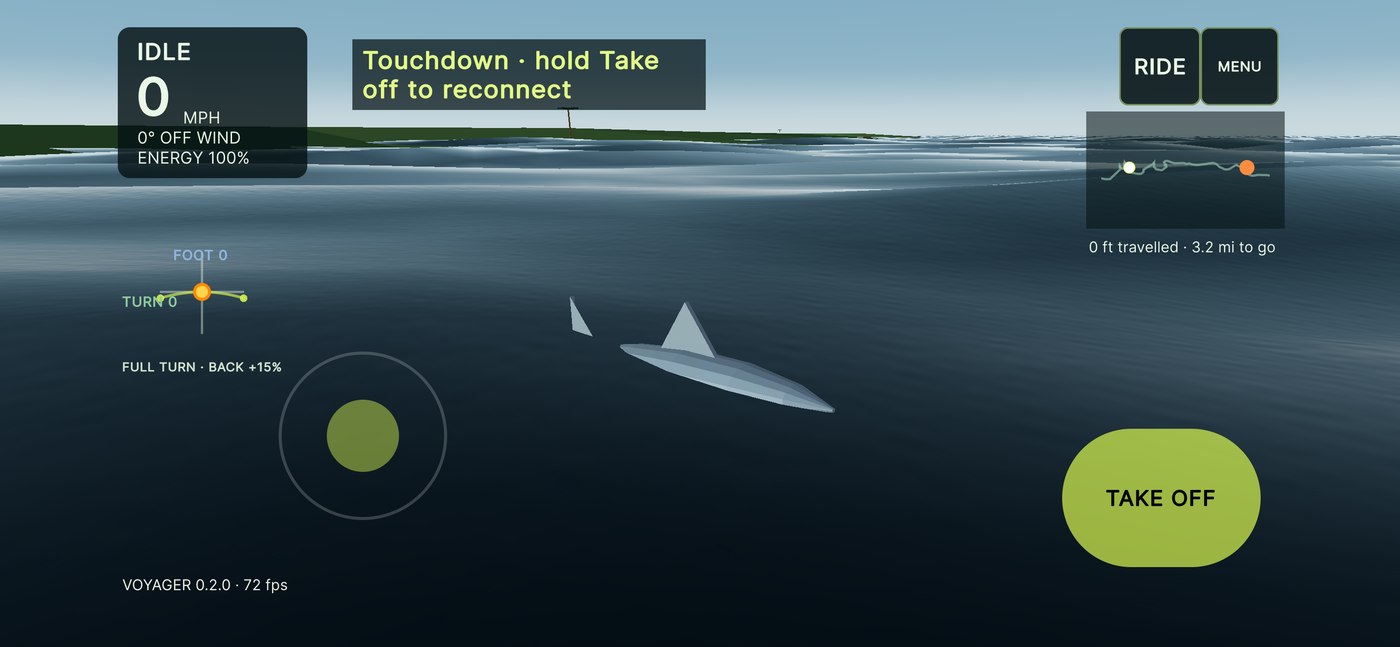
Pull the slider toward Paddle to stroke. Match the water speed to maintain pace without spending energy, or pull faster to accelerate at an energy cost. A slower pull adds no drive. Each stroke gives haptic feedback.
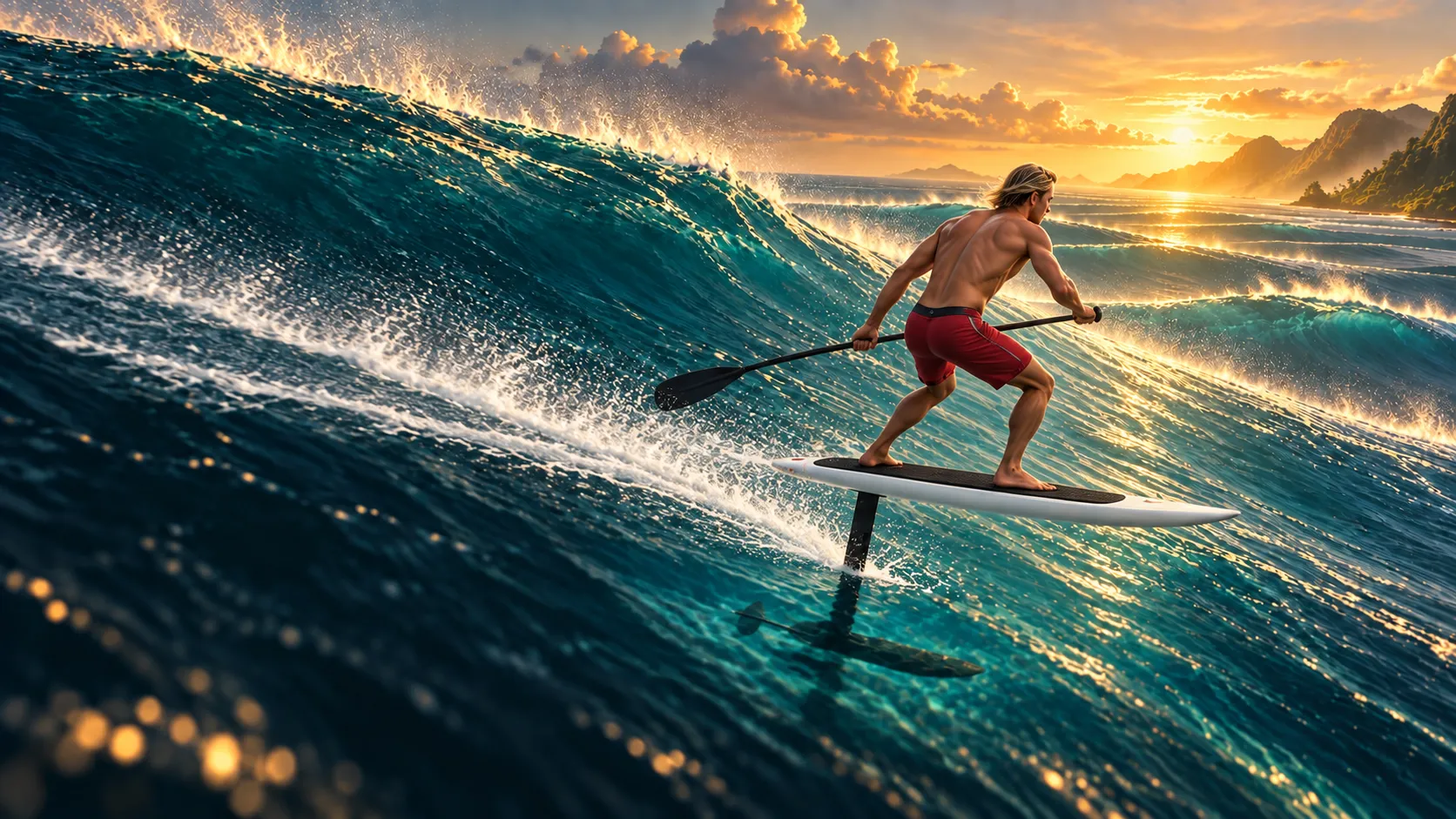
SUP foiling game / iPhone
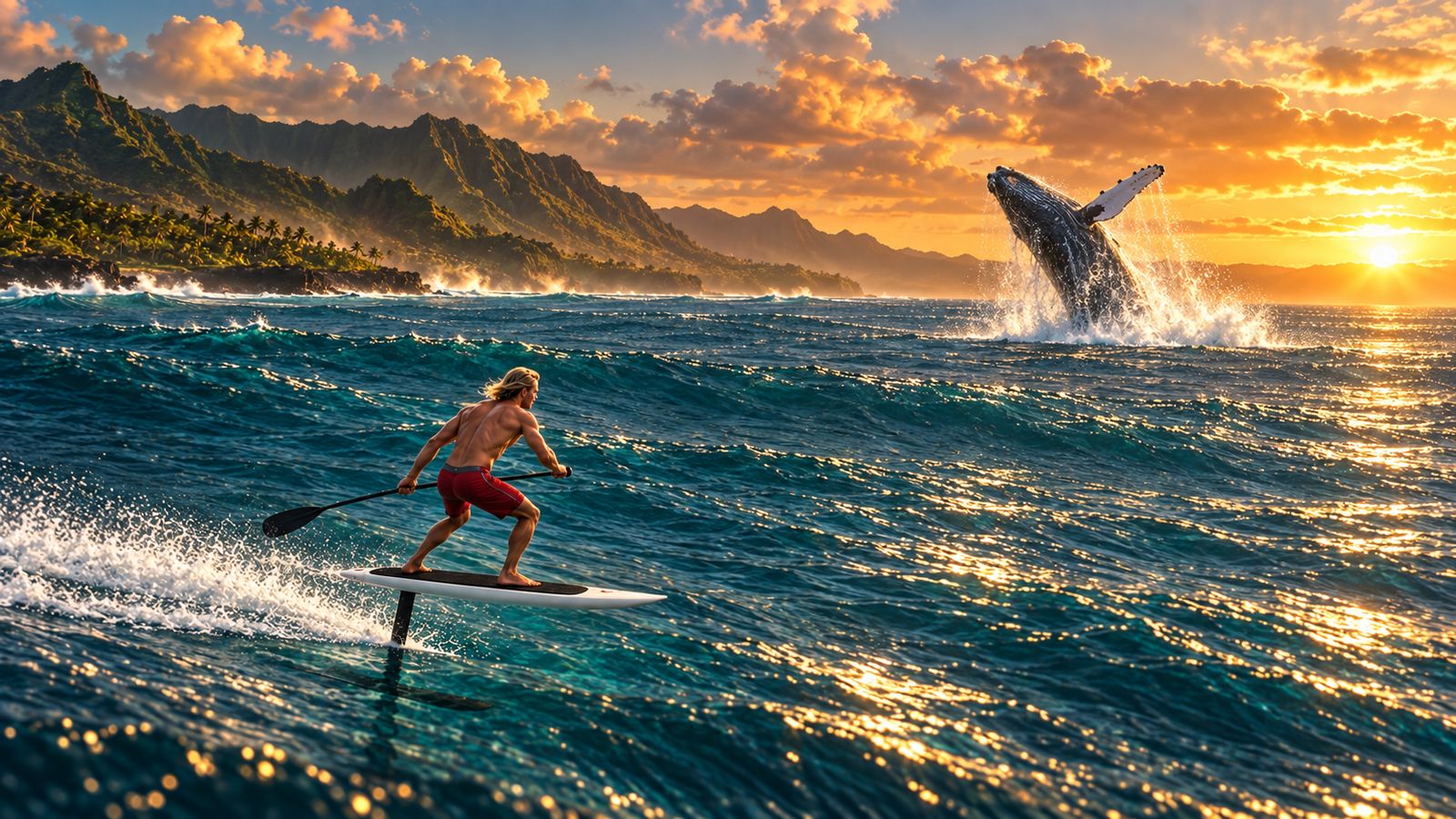
Paddle up and link bumps along Oahu’s North Shore and through the Columbia River Gorge. Carry speed through the turns, pump through the lulls and work your way downwind. Sharks, whales and lifeguard jet skis share the course. In development for iPhone.
THE DOWNWIND RUN
Once you’re on foil, the run is about making connections. Turn off a face with enough speed to reach the next bump, use a few pumps to cross a flat spot, and adjust your line as the swell changes. Set the conditions yourself, then repeat the same sea to compare your runs.
GAMEPLAY FOOTAGE
Gameplay footage comes from development builds. The opening image and illustrated route scenes are labeled as concept art.
CONTROLS
Steer and lean with the stick; paddle and pump with the slider. Learning gives you the most support and recovery assistance, while Medium and Advanced demand more precise timing. You can choose any wave size at every difficulty.
Pull the slider toward Paddle to stroke. Match the water speed to maintain pace without spending energy, or pull faster to accelerate at an energy cost. A slower pull adds no drive. Each stroke gives haptic feedback.
Move the slider toward Pump, or hold the Pump end and release. A longer hold takes the rider lower and produces a stronger push on release, up to a limit. Pumping uses the rider’s energy reserve.
Move the stick left or right to bank the board and hold it to continue the turn. Steeper banks demand more lift from the foil. Choose your exit with the next moving face in view.
Push the stick up to load the front foot. A tap gives about two seconds of boost; holding extends it to four. A brief loss of speed follows on flat water, and holding too long sinks the foil. That speed penalty is waived on a descending wave face.
Hold Pump and push the stick fully left for a sustained heel-side cutback, with the paddle blade dragging through the water and throwing spray.
Hold Pump and push right. The rider lowers his hands and reaches the paddle out, dragging the blade through the turn.
Touch the Paddle side and flick the stick down to switch the paddle across the board for a reverse-paddle turn. The rider then switches it back.
With the slider on Paddle, push the stick up to link a toe-side carve into a heel-side carve. This move is still being tuned.
When a shark comes within about 15 feet, the Paddle control changes to STRIKE. The rider releases his rear hand and swings the blade down at the shark.
OCEAN AND FOIL PHYSICS
Voyager calculates lift and drag from the water moving past the foil. Speed, bank and trim change the forces through a turn, while adjustable assistance helps with stability and recovery.
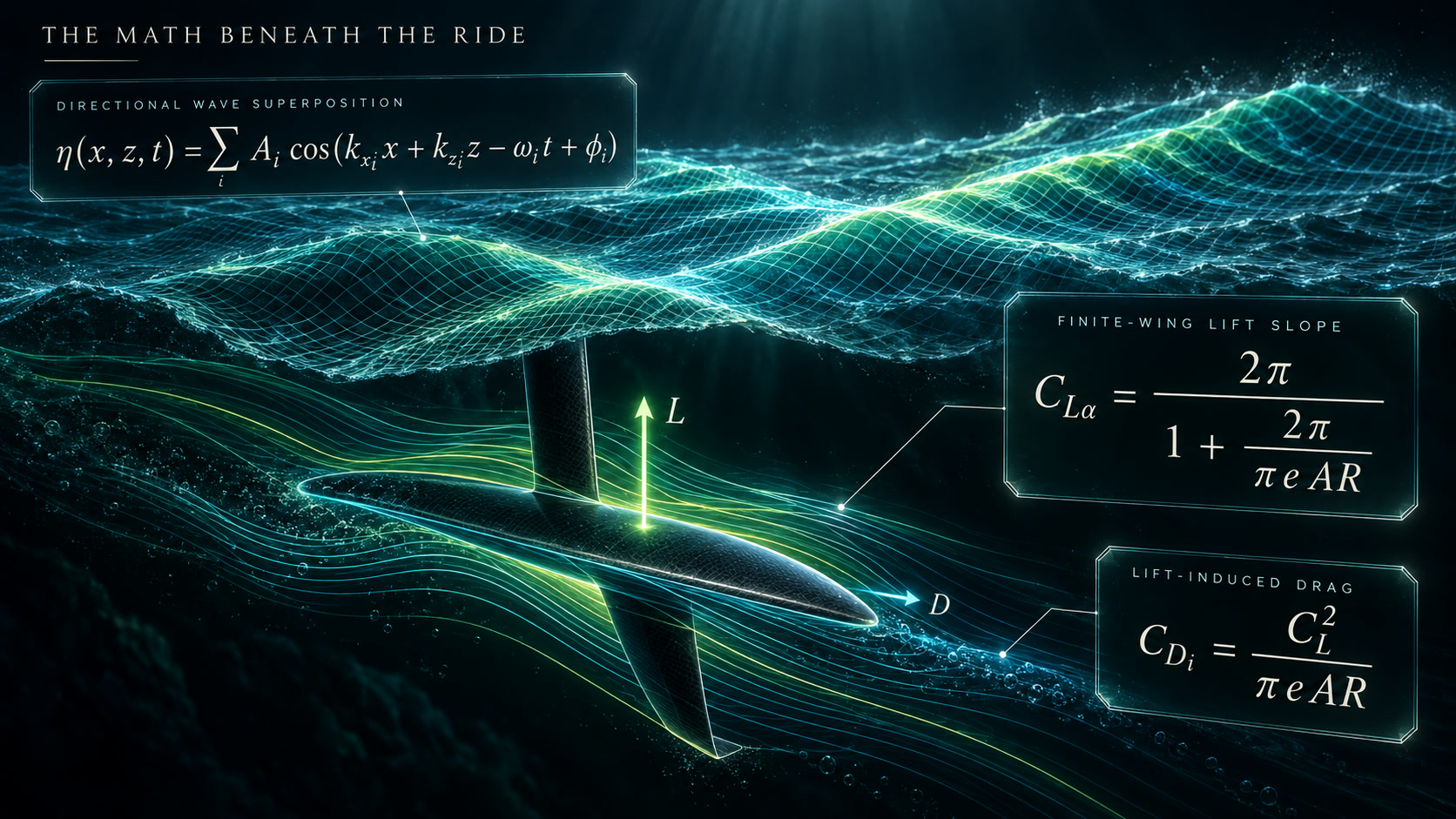 View the illustration ↗
The surface combines wave components with their own amplitude, direction, phase and frequency. Wind swell and ground swell overlap, changing the shape of the faces as they pass through one another.
A sets amplitude, k sets wavelength and direction, and ω sets angular frequency. The model uses the deep-water relationship ω² = gk: longer waves travel differently from short chop. Surface height and slope help the game identify useful wave energy; that riding cue is a gameplay estimate, not a measurement in joules.
The foil responds to speed relative to the moving water. Wing area and angle of attack affect lift too, so two moments at the same displayed speed can feel different. Drag grows with that same dynamic pressure.
Drag follows D = ½ ρv²SCD. Voyager combines profile, lift-induced, and near-surface spray terms. Its induced-drag coefficient uses CDi = CL² / (πeAR), linking lift demand to wing aspect ratio and efficiency.
Your foil meets water that is already moving. Changing pitch or trim changes its angle of attack, affecting lift and drag. Push beyond the model’s stall angle and lift falls away; bring a wing through the surface and support changes again.
The front wing and stabilizer contribute forces and pitch moments. Bank into a turn and some support points sideways. Demand more lift and induced drag rises. The model also responds to stall and wing immersion, with assistance adjusted by difficulty.
LIFT AND DRAG / SPEED SQUARED
Hold wing area, water density, and coefficients fixed. Change only the water-relative speed.
Illustrative equation, not live game telemetry. During a ride, angles, coefficients, immersion, and assists also change.
Voyager combines spectral waves, simplified hydrodynamics, and gameplay assistance. The wave-energy cue estimates useful riding conditions from the surface; it is not an energy reading in joules. Read the field notes and equations ↗
LINE CHOICE
Change one setting and repeat a run to compare your speed, ride height and turning room. The same stretch of water gives you a way to judge each adjustment.
Watch the direction of the face as well as its height. The push you can use depends on your heading, speed and position on the bump.
Build speed down the face and turn toward the next bump before the swell flattens. Pump through the gap when you need to, allowing for the energy each pump uses.
Speed, trim and wing immersion determine how much support you have. A steep bank increases the lift required to hold your height.
Real waves transport energy. Voyager models the moving water and foil forces, with added wave-face support and recovery assistance for playability. These relationships can be explored in the game; actual foiling still requires on-water instruction and judgment.
Follow the energy through the model ↗THE COURSES
Oahu’s North Shore, 2.8 miles downwind from Turtle Bay to the beach at Freddieland. Sharks, whales, sea turtles and a lifeguard jet ski share the course. Near the finish the bumps soften, and a timed swell will carry you in if you catch it.
Turtle Bay to Freddieland · Oahu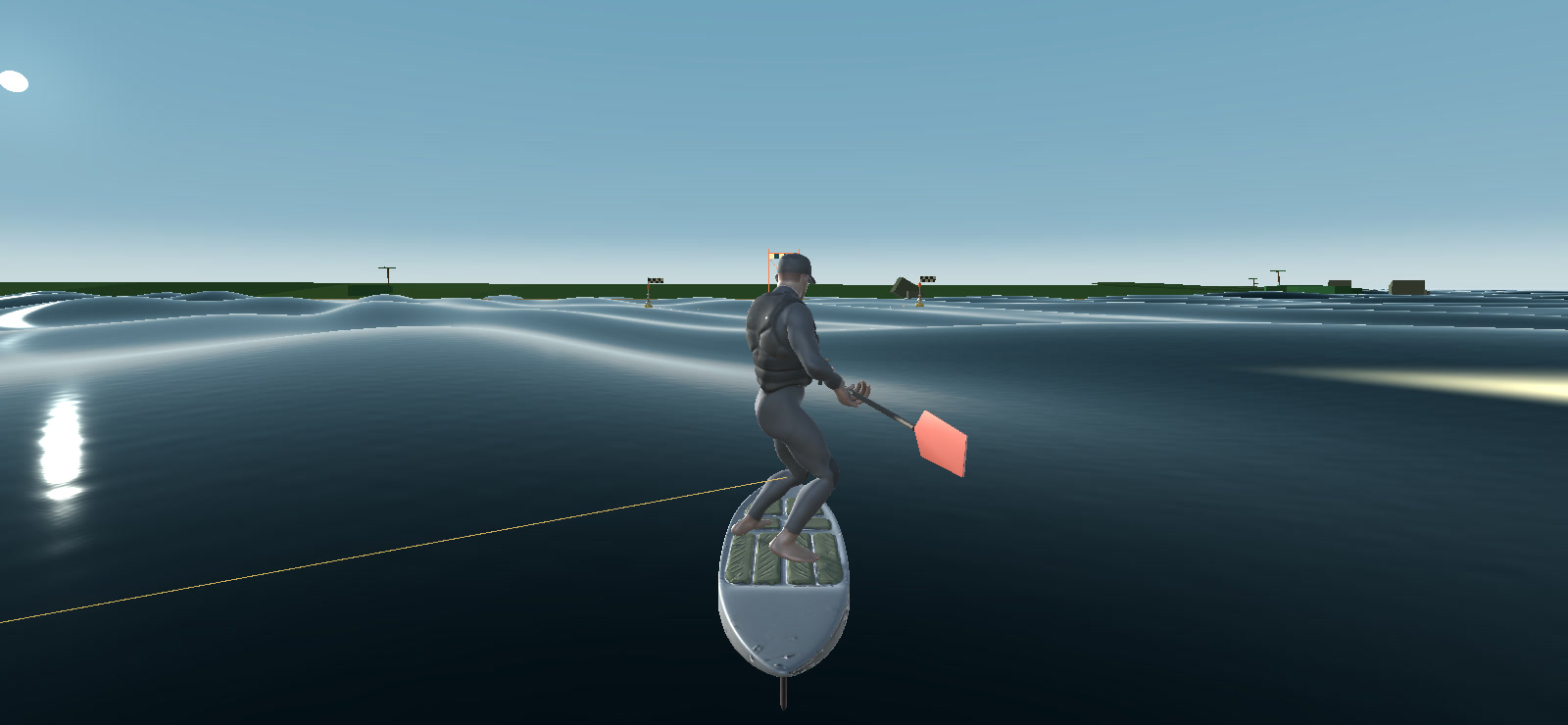
A six-mile run down the Columbia River from Rufus to Giles French Park, built over real terrain data. Link wind bumps beneath the bridge and through barge and patrol-boat traffic on the way to the finish.
Rufus to Giles French · Columbia River Gorge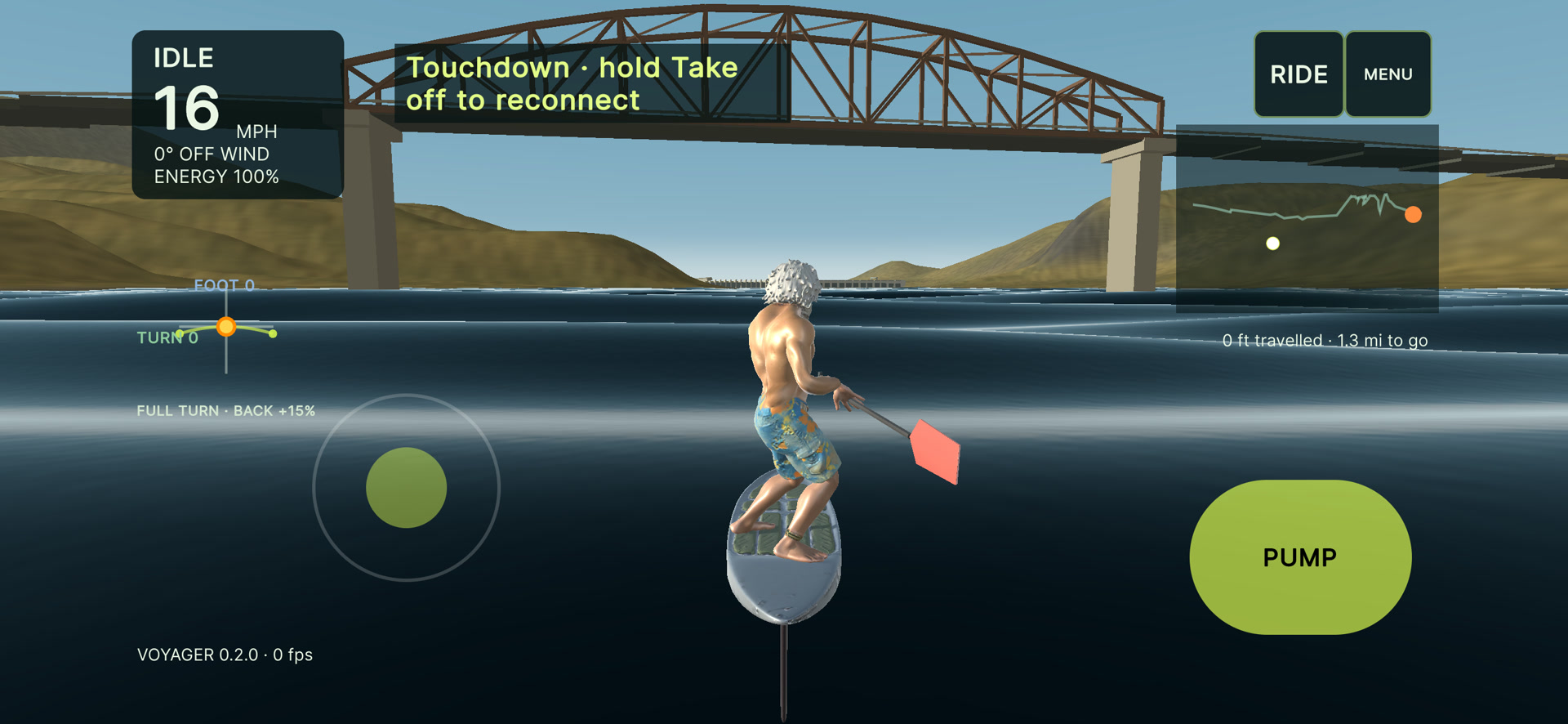
Launch beside Tunnel 4 west of the Hatchery and finish at the mouth of the White Salmon River, with the Hood River bridge farther east. Barges work the river, and a mecha shark patrols it.
The Hatch · Columbia River Gorge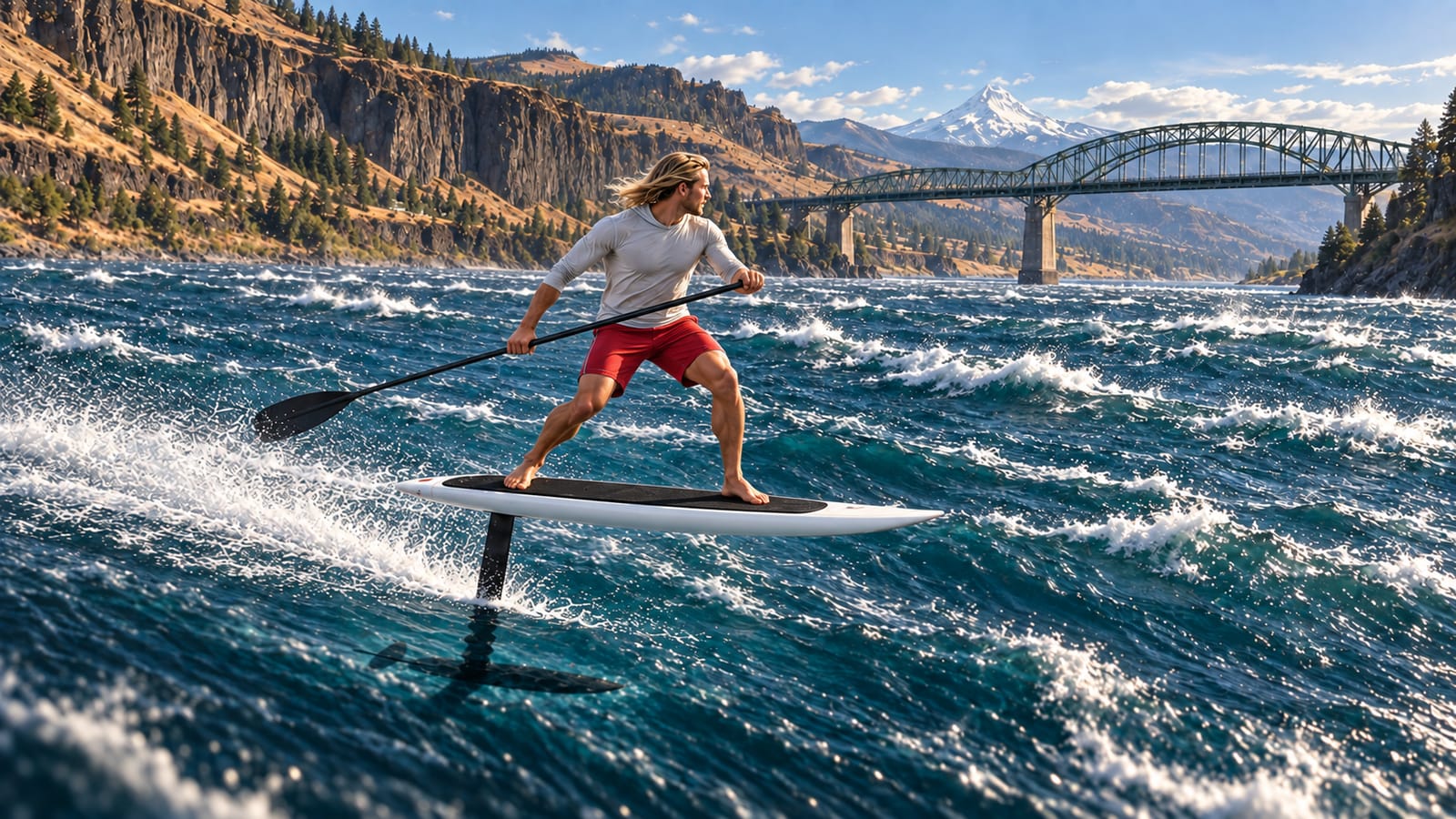
A fictional 3 km offshore course between weather-buoy gates in a 20 ft storm sea. Steep drops, crossing ship wakes and an oil platform make this a more exposed run.
Bering Run · offshore storm · fictional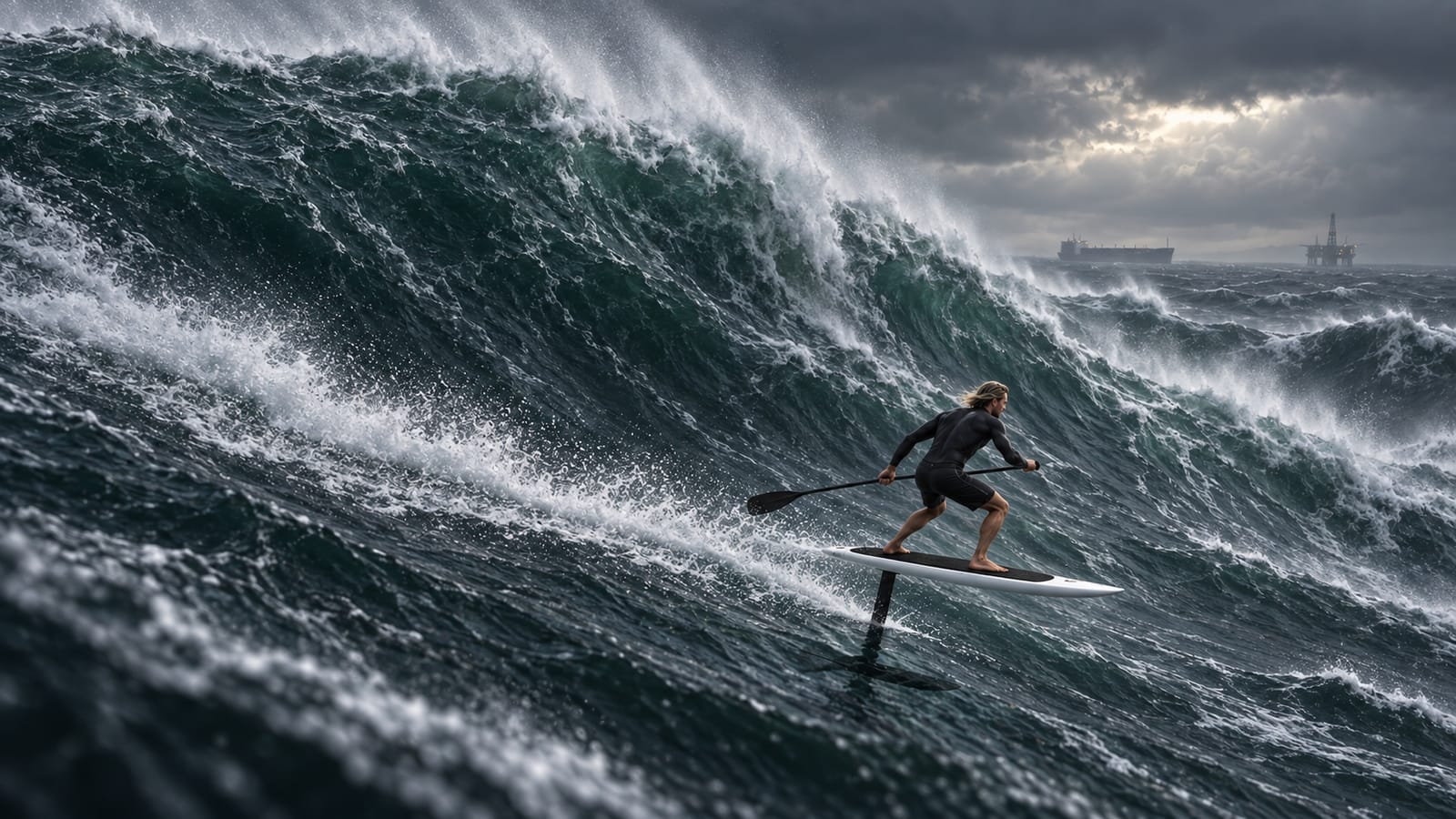 CONCEPT ART
The remaining courses are Sunset, with long glassy shoulders and left or right lines ending at buoy markers; Viento Express, a 1.5 km Gorge practice course; and a 400 m warm-up. The coastal and river routes draw on real locations; Bering Run is fictional. Coastlines and scenery are still being refined, as shown in the development captures.
INTERACTIVE WAVE LAB
Mix short wind swell with a longer ground swell, then move both toward a beach or reef shelf. Shallow water shortens the wavelength and bends the wave paths toward shore.
An educational wave model. Height here means crest to trough for each simple wave. The game uses a spectrum of many components; its wave-size setting describes a sea state. Coastal effects here are a teaching extension, not a simulation of either race course.
Across the beach shelf, both wave trains slow and shorten near shore. The wind swell turns from 55° to 17°, while both selected periods stay fixed.
TRAFFIC / WILDLIFE
Sharks circle before striking, whales breach, and sea turtles surface along your line. Lifeguard jet skis, barges and ships cross the course. Collisions throw the rider according to the angle of impact. Adjust each hazard’s frequency and intensity in the settings.
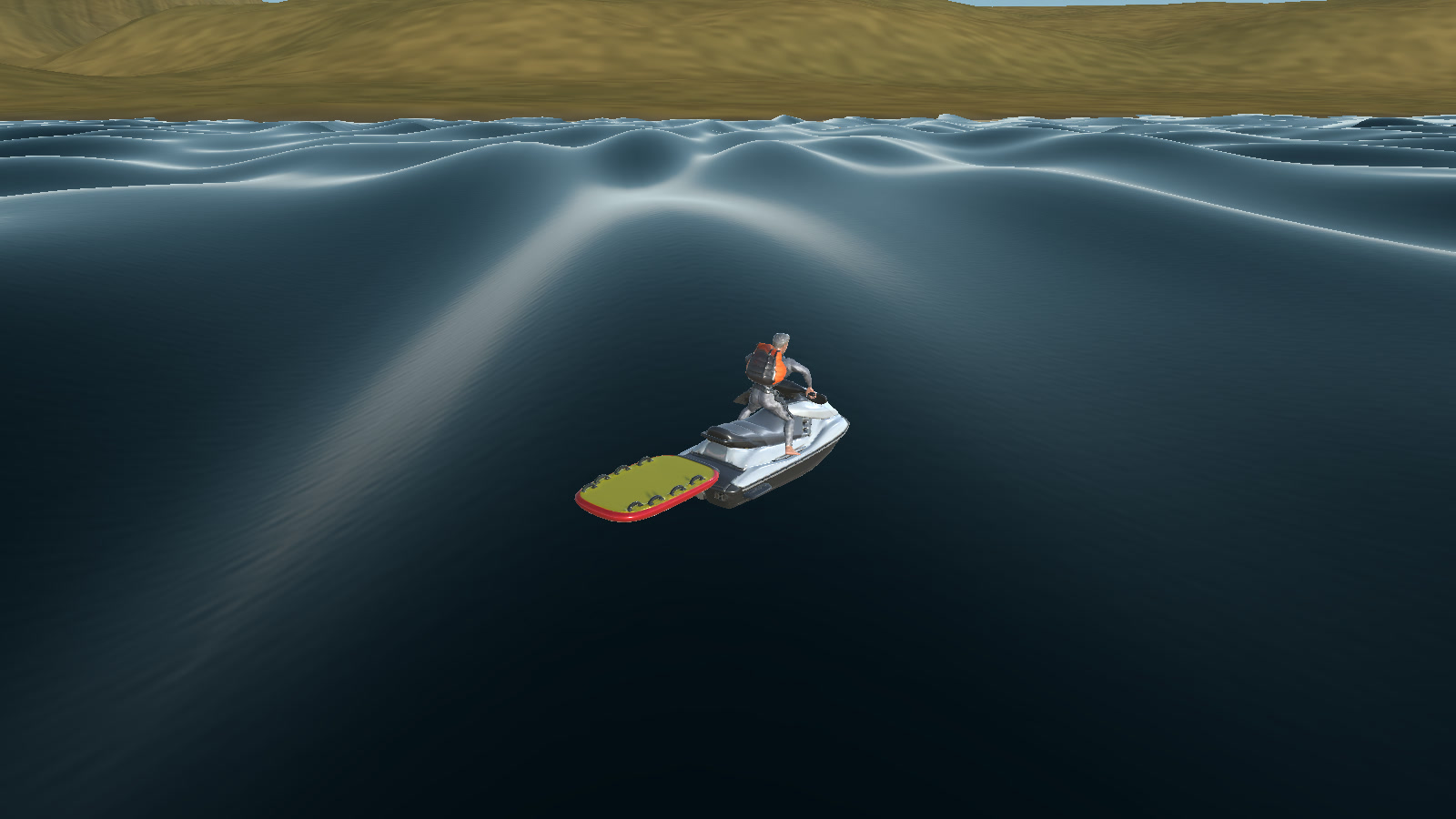
 CONCEPT ART
Honu surface to breathe, leaving a splash. A collision stops the foil and throws the rider; the turtle dives away unharmed.
ENCOUNTER MODELS
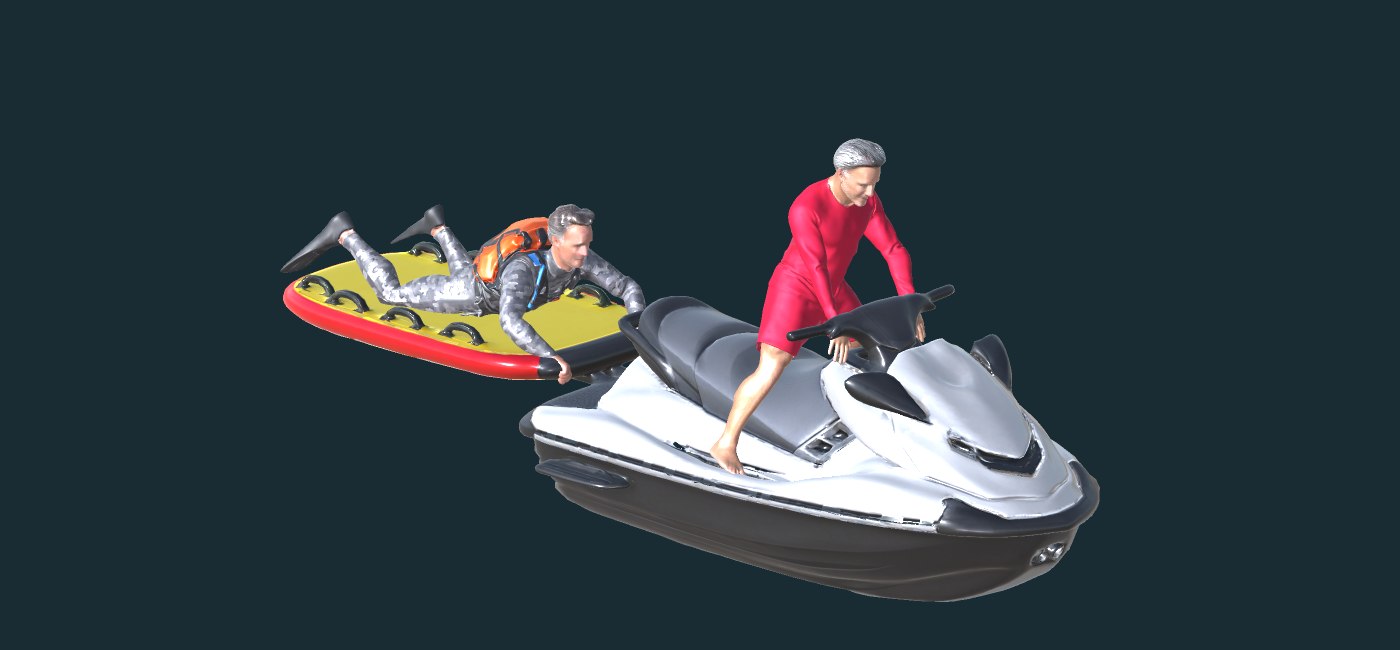
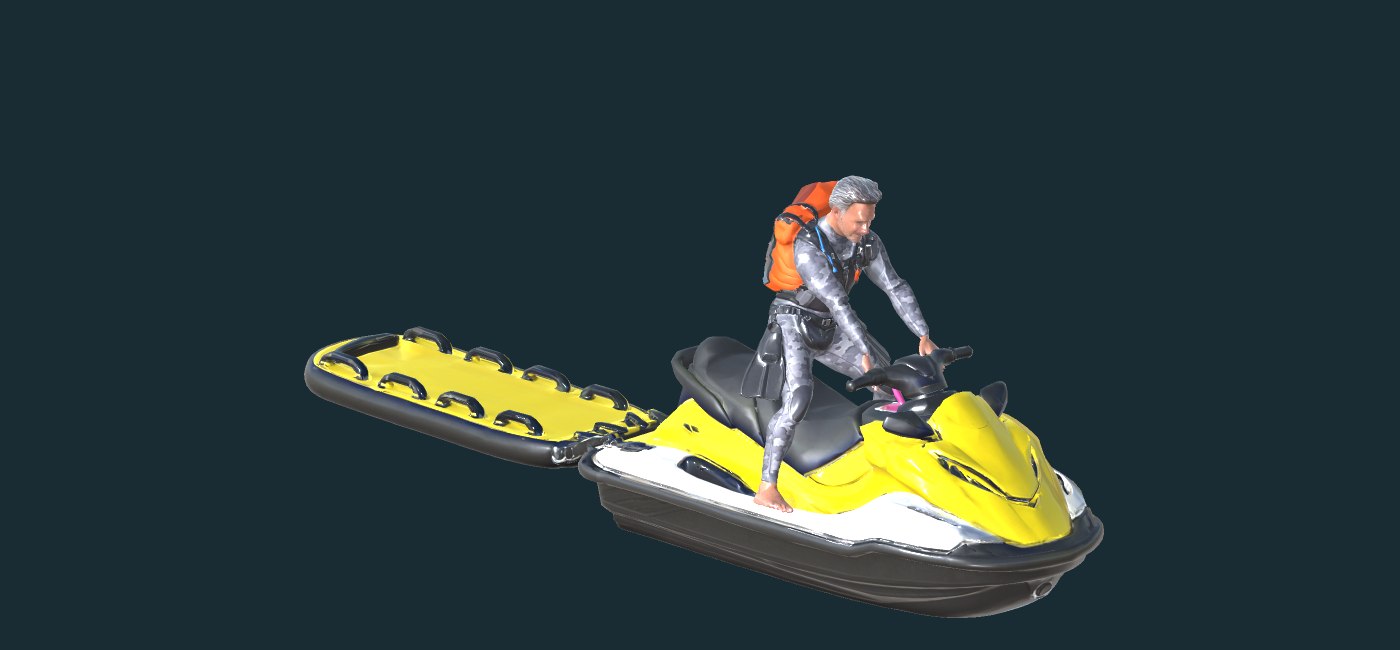
The rescue craft use the game’s rider models, with a driver and a second lifeguard on the rescue sled.
Rotating source models show two red-uniform crew; crew differs from the game captures.
THE RIDER ROSTER
Eight riders are selectable in the current development build. Core Lord Zack is the only rider past candidate stage, with the other seven still being tuned. Nine additional models remain in the game files but are unavailable in the chooser. The bios are fictional character profiles. Portraits come from the game’s rider selection screen; rotating models show the 3D assets rather than gameplay animation.
PLANNED DEVELOPMENT
Timed routes, wildlife and the storm run are in the current build. The features below are planned.
Timed runs and personal bests are already recorded in the game. Online rankings are planned for comparing runs with other players.
Leaderboards · plannedIndividual stances, paddle carries and turning styles for each rider.
Distinct movement styles · plannedA choice of foils with different takeoff speeds, glide and turning characteristics, with selection and tuning planned.
Foil selection and tuning · plannedTurtle Bay and Rufus already use satellite and aerial imagery. Further work on Turtle Bay will add detail to the hotel, headlands and beach finish at Freddieland, as seen from the water.
Coastal scenery pass · plannedIPHONE BETA
Voyager is in development for iPhone. A limited beta is planned once ride feel, courses and performance are ready.
Public downloads and signups are not open yet.
Watch gameplayVOYAGER / iPHONE / IN DEVELOPMENT